
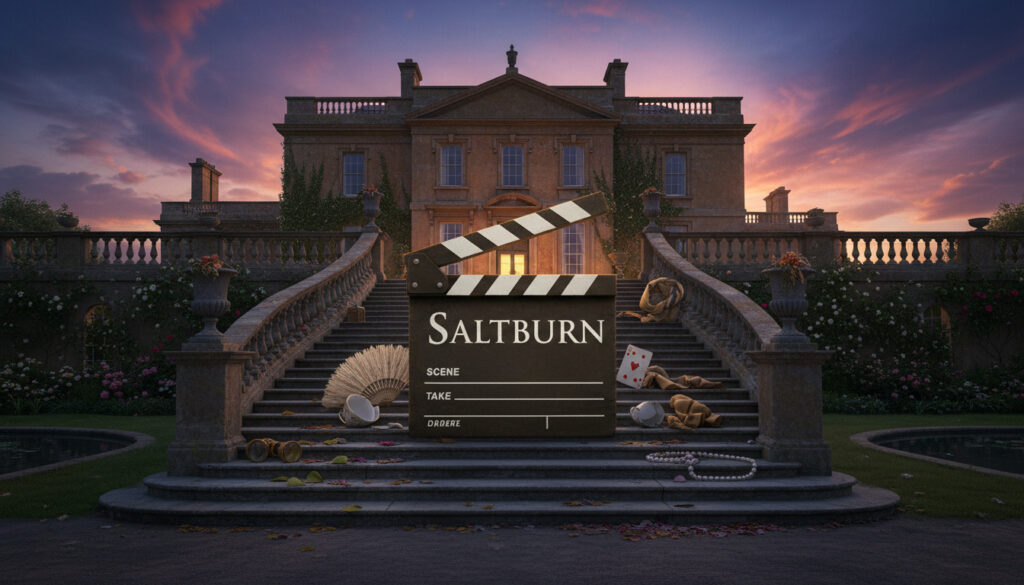
Emerald Fennell’s 2023 psychological thriller Saltburn assembles a distinctive ensemble that dissects British class obsession through the prism of an aristocratic Oxford clique. The film centres on a web of toxic desire and social climbing, brought to life by performances that range from simmering restraint to grotesque excess.
Led by Barry Keoghan as the calculating Oliver Quick and Jacob Elordi as the magnetic Felix Catton, the cast navigates themes of privilege and parasitic friendship within the gilded walls of a sprawling estate. Their performances anchor a narrative that questions whether true entry into the upper echelons is ever possible, or merely a performance observed through the polished glass of Saltburn itself.
The supporting roster features established British talent alongside emerging actors, creating a textured portrayal of inherited wealth and outsider aspiration. From the languid cruelty of Rosamund Pike’s aristocratic matriarch to the desperate vulnerability of Alison Oliver’s troubled heiress, each character contributes to Fennell’s exploration of beauty, decay and manipulation.
Who Are the Main Actors in Saltburn?
Saltburn centres on four performers whose careers span independent cinema, prestige television and blockbuster franchises. Their casting reflects deliberate choices regarding physicality, class signifiers and the ability to convey moral ambiguity.
| Actor | Role | Notable For |
|---|---|---|
| Barry Keoghan | Oliver Quick | The Banshees of Inisherin |
| Jacob Elordi | Felix Catton | Euphoria |
| Rosamund Pike | Elspeth Catton | Gone Girl |
| Richard E. Grant | Sir James Catton | Withnail & I |
Key Casting Insights
- Barry Keoghan brings BAFTA-winning intensity to Oliver, marking a shift from his previous ensemble work into leading anti-hero territory
- Jacob Elordi transitions from teen screen idol to complex dramatic lead, embodying aristocratic ease through physical posture and vocal patterns
- Rosamund Pike reunites with Fennell to deliver a performance of surface charm masking absolute ego, drawing comparisons to her earlier manipulative characters
- Richard E. Grant captures the specific exhaustion of inherited responsibility, portraying a patriarch simultaneously powerful and irrelevant
- The contrast between Keoghan’s Preston working-class energy and Elordi’s Australian-born but distinctly British-coded privilege drives the film’s central tension
- Supporting principle players include Alison Oliver (as Venetia Catton), Archie Madekwe (as Farleigh Start) and Carey Mulligan (as Poor Dear Pamela)
- Cinematographer Linus Sandgren and editor Victoria Boydell collaborated to frame these performances within 4:3 aspect ratio compositions that emphasize social claustrophobia
Saltburn Cast Facts
| Lead Actor | Barry Keoghan |
| Director | Emerald Fennell |
| Release Year | 2023 |
| Genre | Black Comedy Thriller |
| Felix Catton Portrayal | Jacob Elordi |
| Lady Elspeth Portrayal | Rosamund Pike |
| Sir James Portrayal | Richard E. Grant |
| Venetia Catton Portrayal | Alison Oliver |
| Farleigh Start Portrayal | Archie Madekwe |
| Producer | Margot Robbie |
| Composer | Anthony Willis |
Supporting Cast and Key Roles
Beyond the central cat-and-mouse dynamic, Saltburn populates its world with characters representing various strata of institutional power and familial dysfunction. These performers flesh out the ecosystem of Oxford University and the eponymous estate.
The Catton Family Circle
Alison Oliver portrays Venetia Catton, Felix’s sister, whose character exhibits the self-destructive tendencies bred by isolated privilege. Archie Madekwe appears as Farleigh Start, Felix’s American cousin, embodying the insecurity of the privileged but less-favoured relative. Carey Mulligan delivers a scene-dominating cameo as Poor Dear Pamela, Elspeth’s desperate hanger-on friend, disappearing beneath prosthetics and pathos.
Oliver’s integration into the Saltburn household relies heavily on his interactions with these satellite figures. The butler Duncan, portrayed by Paul Rhys, serves as the silent observer of the family’s moral decay, representing the staff who witness but never intervene in aristocratic excess.
Oxford Peers and Working-Class Roots
The Oxford sequences feature Ewan Mitchell as Michael Gavey, Sadie Soverall as Annabel, and Millie Kent as India, illustrating the casual exclusivity of university social hierarchies. These characters provide the initial audience for Oliver’s performative vulnerability.
Contrasting the estate’s opulence, Dorothy Atkinson and Shaun Dooley appear as Paula and Jeff Quick, Oliver’s presumably working-class parents, though the film questions the veracity of Oliver’s background. Reece Shearsmith cameos as Professor Ware, embodying academic authority.
Full Cast List of Saltburn
The complete credited ensemble extends beyond the principal narrative figures to include household staff, peripheral Oxford students and estate visitors. These roles, while smaller, contribute to the film’s granular sense of place and social texture. Main cast credits align across Fandango, Rotten Tomatoes and Wikipedia listings, while minor roles documented by TV Guide show some variation across sources.
Complete Cast Breakdown
Paul Rhys appears as Duncan, the butler whose silent judgment permeates the household. Lolly Adefope portrays Lady Daphne, while Joshua McGuire plays Henry, both guests at the estate who represent the wider aristocratic social circle.
Additional Oxford students include Richie Cotterell as Harry, Will Gibson as Jake, Tasha Lim as Camilla, Aleah Aberdeen as Alicia, Matt Carver as Benjy, and Gabriel Bisset-Smith as Reg Starter. The household staff extends to Saga Spjuth-Säll as Sam, with Glyn Grimstead appearing as a taxi driver. Oxford scenes feature Joshua Samuels as Liam and Julian Lloyd Patten as Joshua.
Emerald Fennell served as director, screenwriter and producer alongside Josey McNamara and Margot Robbie. Linus Sandgren’s cinematography and Victoria Boydell’s editing shaped the distinctive visual language that frames these performances.
Production Timeline and Casting Milestones
- : Casting announcements commence with Barry Keoghan and Jacob Elordi attached to lead roles; Emerald Fennell confirmed as director following her Academy Award success with Promising Young Woman
- : Principal photography concludes after location shooting at various English estates, with the cast having worked through the summer and autumn
- : Theatrical release in United Kingdom and United States cinemas, following premieres at international film festivals
- : Streaming distribution begins on Amazon Prime Video, expanding the film’s audience beyond theatrical markets
Verified Cast Information and Outstanding Questions
| Confirmed Performances | Outstanding Questions |
|---|---|
| Barry Keoghan appears as Oliver Quick, as documented by IMDb and official press releases | Rumoured cameo appearances by unlisted actors remain unverified across official sources |
| Jacob Elordi’s role as Felix Catton appears across all major entertainment databases | Specific audition processes for supporting Oxford student roles remain undisclosed |
| Rosamund Pike and Richard E. Grant appear as Elspeth and Sir James Catton respectively | Extent of improvised dialogue versus strictly scripted lines for ensemble scenes |
| Emerald Fennell’s triple role as writer/director/producer confirmed by industry trade publications | Whether scenes featuring minor billed actors were reduced during editing |
| Film classification by the BBFC confirms cast list for rating purposes | Details of salary disparities between established stars and debut performers |
Casting Direction and Key Production Decisions
Emerald Fennell’s approach to casting Saltburn prioritized performers capable of conveying contradictory impulses—charisma masking emptiness, vulnerability concealing calculation. The director, who previously helmed Promising Young Woman, sought actors who could inhabit the grotesque without alienating the audience entirely.
The production team, including producers Josey McNamara and Margot Robbie through their LuckyChap Entertainment banner, supported Fennell’s preference for mixing established stars with emerging talent. This strategy mirrors approaches seen in other recent ensemble thrillers, where familiar faces anchor riskier narrative choices.
The Cast of Killers of the Flower Moon – Ensemble Insights demonstrates similar casting philosophies in prestige dramas, balancing box-office draws with character actors capable of subtle menace.
The Casting Philosophy Behind Saltburn
Fennell’s casting choices deliberately contrast performers associated with specific class backgrounds against those known for transformative range. Keoghan’s established screen persona—rooted in Irish working-class authenticity—provides the perfect foil for Elordi’s physical embodiment of effortless privilege. This friction generates the film’s underlying voltage.
The inclusion of veterans like Grant and Pike alongside relative newcomers Oliver and Madekwe creates a generational tension within the performances. The experienced actors bring the weight of British cinematic history—Grant’s connection to cult independence, Pike’s association with icy precision—while the younger cast represents the uncertain future of British class structures.
Such strategic ensemble construction appears increasingly common in prestige cinema, where the Cast of Dune 2 – Dynamic Ensemble Elevates Story similarly blends emerging talent with established authorities to create complex narrative ecosystems.
Statements from the Cast and Creator
Emerald Fennell specifically sought Barry Keoghan for his ability to convey dangerous intensity beneath a surface of vulnerability, essential for Oliver’s manipulative charm and the film’s exploration of parasitic relationships.
— Variety, 2023
The cast reportedly underwent minimal rehearsal, with Fennell preferring to capture the awkwardness of new acquaintance on camera. Elordi and Keoghan developed their characters’ physical dynamics through proximity rather than dialogue, reflecting the script’s emphasis on observation over conversation.
Saltburn Cast Overview
The ensemble of Saltburn functions as a carefully calibrated mechanism for dissecting English class anxiety, with Barry Keoghan’s Oliver Quick infiltrating a world defined by Jacob Elordi’s Felix Catton and his parents, Rosamund Pike and Richard E. Grant. Supported by Alison Oliver, Archie Madekwe and Carey Mulligan, the cast creates a claustrophobic environment where privilege proves both impervious and fragile. Emerald Fennell’s direction unifies these performances into a cohesive critique of desire and ownership.
Frequently Asked Questions
Is Barry Keoghan in Saltburn?
Yes, Barry Keoghan plays the lead role of Oliver Quick, the scholarship student who becomes obsessed with his wealthy classmate Felix Catton. This performance follows his acclaimed work in The Banshees of Inisherin and The Killing of a Sacred Deer.
Who plays Oliver Quick’s parents in Saltburn?
Dorothy Atkinson portrays Paula Quick and Shaun Dooley portrays Jeff Quick, appearing in brief sequences that establish Oliver’s claimed working-class background, though the film questions the veracity of his familial narrative.
What character does Carey Mulligan portray?
Carey Mulligan appears as Poor Dear Pamela, a heavily made-up friend of Elspeth Catton who visits the estate. Despite limited screen time, her performance creates a memorable impression of desperation and faded glamour.
Are there any verified cameo appearances in Saltburn?
While Reece Shearsmith appears as Professor Ware in a credited supporting role, rumours of additional uncredited cameos by major stars remain unverified across official sources such as IMDb or Rotten Tomatoes.
Did the Saltburn cast receive awards recognition?
The film generated significant awards season discussion, particularly for Keoghan and Pike, though specific nominations varied by ceremony. The cast collectively received recognition at various critics’ associations for ensemble work.
Who plays the butler Duncan in Saltburn?
Paul Rhys portrays Duncan, the observant butler who serves the Catton family. His character functions as the silent witness to the family’s moral decay, representing the institutional memory of the aristocratic household.
Related stories





Leon Carter covers cinema releases, movie cast guides and filmographies.