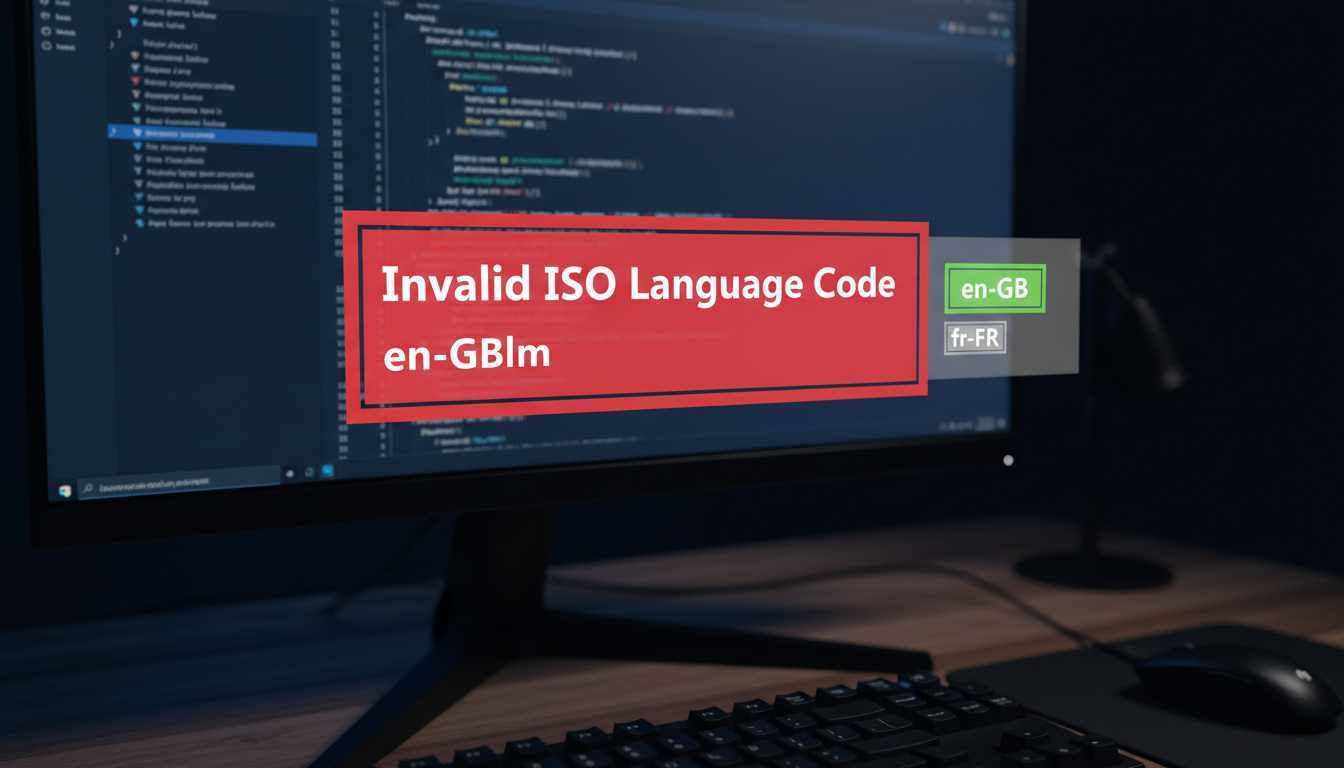
The alphanumeric string “en-GBlm” periodically surfaces in technical queries and data validation checks, yet it corresponds to no recognised entry within international language standards. Analysis of ISO 639 registers and IETF language tag specifications indicates this sequence represents a malformed or mistyped variant of legitimate British English coding, rather than an established linguistic identifier.
Understanding why this particular string lacks authority requires examining the precise architecture of ISO language classification. The code deviates from sanctioned formats in ways that render it invalid for software localisation, content management systems, and digital publishing workflows.
This examination clarifies the distinction between valid regional variants such as en-GB and erroneous constructions, whilst mapping the structure of standardised language identification systems.
What is en-GBlm and does it hold ISO certification?
Comprehensive searches across ISO 639-1, ISO 639-2, and ISO 639-3 databases confirm that “en-GBlm” possesses no standing as a registered language code. Documentation from translation standards authorities establishes that whilst “en-GB” denotes British English specifically, the appended “lm” suffix corresponds to no recognised subtag within the IETF BCP 47 specification.
| Standard Status | Not recognised / Invalid |
| Probable Origin | Typographical error or malformed locale tag |
| Correct Equivalent | en-GB (British English) |
| Governing Standards | ISO 639-1, ISO 639-2, IETF BCP 47 |
Several distinct factors contribute to this classification:
- No entry exists across ISO 639-1 (two-letter), ISO 639-2 (three-letter bibliographic/terminologic), or ISO 639-3 (compprehensive language) code lists
- The structure violates IETF BCP 47 formatting rules for language-region combinations
- “lm” does not correspond to any registered language subtag, script, or variant indicator
- Official ISO 639-2 listings enumerate English as “en” or “eng” exclusively
- GB represents Great Britain within ISO 3166-1 territory standards, yet requires precise formatting
- Similar valid codes include Limburgish (“lim”) and Lingala (“lin”), neither relating to the GB region
| Attribute | Value |
|---|---|
| Code Status | Invalid / Non-existent in ISO registers |
| Standard System | ISO 639 (not listed) |
| Likely Intended Code | en-GB |
| Language Component | en (English – valid) |
| Region Component | GB (Great Britain – valid) |
| Invalid Suffix | lm (no standard meaning) |
| Valid Two-Letter Code | en (ISO 639-1) |
| Valid Three-Letter Code | eng (ISO 639-2/3) |
| Historical English Variant | enm (Middle English, 1100–1500) |
| Limburgish Code | lim (ISO 639-1) |
| Lingala Code | lin (ISO 639-1) |
How does the ISO 639 standard structure language identification?
The International Organization for Standardization maintains distinct yet interoperable systems for cataloguing human languages. These frameworks ensure consistent identification across bibliographic records, software interfaces, and linguistic research.
Two-letter codes under ISO 639-1
ISO 639-1 establishes alpha-2 codes representing major living languages. The Library of Congress maintains the canonical registry, assigning “en” to English without regional specificity. These codes function primarily in bibliographic contexts and computer systems requiring compact identifiers.
Three-letter extensions and comprehensive coverage
ISO 639-2 and 639-3 expand coverage using alpha-3 codes. The former separates bibliographic (“eng”) and terminologic (“eng”) entries, whilst the latter—maintained by SIL International—documents over seven thousand languages including historical forms such as Middle English (“enm”).
IETF BCP 47 combines ISO 639 language codes with ISO 3166 region codes using hyphen separators. Valid British English appears as “en-GB”, utilising the two-letter region code for Great Britain. Any additional subtags require registration with the Language Subtag Registry.
What distinguishes valid English language variants?
English language coding accommodates both macro-language identification and regional specificity. Understanding the hierarchy prevents implementation errors in content management systems.
Primary language tags versus regional specifications
Generic English receives the code “en” under ISO 639-1, suitable when regional variation proves irrelevant. W3C accessibility guidelines reference these codes for web content language declaration.
Common regional variants
Specific geographic implementations utilise compound tags: “en-US” for American English, “en-CA” for Canadian English, “en-AU” for Australian English, and “en-GB” for British English. These follow strict formatting rules prohibiting additional characters beyond the specified pattern.
When configuring content management systems or HTML lang attributes, verify codes against the IANA Language Subtag Registry. Invalid sequences such as “en-GBlm” may cause parsing failures or default to browser settings, undermining localisation efforts.
Why might malformed codes like en-GBlm appear in technical contexts?
Invalid language strings typically emerge through three primary mechanisms: manual entry errors where typists append extraneous characters to valid codes, software bugs generating concatenated strings, or confusion regarding subtag ordering. The “lm” suffix in “en-GBlm” possibly represents keyboard proximity errors or misinterpretation of similar-looking valid codes such as “lim” (Limburgish).
Database migration processes occasionally compound such errors when scripts fail to validate against ISO standards. Content localisation for entertainment properties, including the Cast of Heartstopper – Full Actors and Characters Guide, requires rigorous validation to ensure metadata integrity across distribution platforms.
Systems accepting user-generated content or importing legacy databases should implement strict regex validation against current ISO 639 and IETF BCP 47 standards. Unvalidated “en-GBlm” entries may propagate through XML sitemaps, RSS feeds, and HTML documents, compromising search indexing and accessibility compliance.
How have language coding standards evolved since inception?
- : ISO 639-1 first published, establishing two-letter codes for 136 major languages
- : ISO 639-2 released, introducing three-letter bibliographic and terminologic codes
- : ISO 639-3 launched, providing comprehensive coverage of all known languages via SIL International oversight
- : IETF BCP 47 consolidated previous RFCs 3066 and 4646, standardising language tag syntax
- : Continuous maintenance through the Language Subtag Registry and ISO/TC 37 technical committees
Ethnologue’s code browser provides contemporary access to these evolving standards, though “en-GBlm” appears in no historical revision.
What facts are established about en-GBlm versus what remains uncertain?
| Established Information | Information That Remains Unclear |
|---|---|
| en-GBlm appears in no ISO 639-1, 639-2, or 639-3 registers | Specific software systems generating this error |
| GB represents Great Britain/United Kingdom in ISO 3166-1 | Frequency of occurrence across web datasets |
| “lm” holds no meaning as a language subtag | Whether specific users consistently mistype this sequence |
| en-GB remains the valid code for British English | Historical context of first documentation |
| Valid similar codes include lim (Limburgish) and lin (Lingala) | Impact on search engine optimisation when encountered |
How do language codes function within content localisation workflows?
Standardised language identifiers enable automated content delivery, subtitle generation, and regional licensing. Theatrical productions such as the Wicked Cast – West End London 2024 Principals rely on accurate metadata tagging for international distribution and accessibility compliance.
When systems encounter invalid codes like “en-GBlm”, fallback mechanisms typically default to server locale settings or generic English, potentially masking intended regional variations. This uncertainty necessitates manual verification during content migration projects.
What do standardisation authorities document regarding language classification?
Primary authorities including the International Organization for Standardization, the Internet Assigned Numbers Authority, and the Library of Congress maintain publicly accessible registries. Consolidated lists of ISO 639 language codes provide cross-referenced indices of valid entries.
ISO 639 provides internationally recognised codes for the representation of names of languages. These codes are widely used in bibliographic records, information systems, and the Internet.
— International Organization for Standardization, TC 37/SC 2
Summary: Understanding the en-GBlm anomaly
The sequence “en-GBlm” constitutes an invalid language identifier lacking recognition within ISO 639 standards or IETF BCP 47 specifications. It likely represents a typographical deviation from “en-GB”, the valid code for British English. Technical implementations should validate against official registers to prevent propagation of such malformed tags, ensuring consistent localisation across digital content and metadata systems.
Frequently asked questions
Is en-GBlm equivalent to en-GB?
No. Whilst en-GB represents valid British English under ISO standards, en-GBlm holds no official status and likely results from typing errors. Systems should utilise en-GB exclusively.
What does the “lm” suffix indicate in language coding?
Within the context of en-GBlm, “lm” carries no standardised meaning. Valid ISO subtags include “lim” for Limburgish and “lin” for Lingala, neither relating to English or Great Britain.
Which ISO standard governs two-letter language codes?
ISO 639-1 establishes two-letter codes for major living languages. English receives the code “en”, whilst regional variants utilise IETF BCP 47 compound tags such as en-GB.
Can en-GBlm be used in HTML lang attributes?
No. The HTML specification requires valid BCP 47 language tags. Invalid codes may trigger browser fallback mechanisms or accessibility validation errors.
How should systems handle database entries containing en-GBlm?
Data cleansing procedures should map en-GBlm to en-GB where British English is contextually appropriate, or to generic “en” where regional specificity is unknown. Validation rules should prevent future entry of non-standard codes.
Are there other common misspellings of British English codes?
Common errors include concatenation (enGB), underscore substitution (en_GB), or case variation (EN-gb). Only hyphenated lowercase “en-GB” conforms to IETF BCP 47 standards.
Related stories





Grace Hollis covers actors, awards season and screen-linked celebrity coverage.