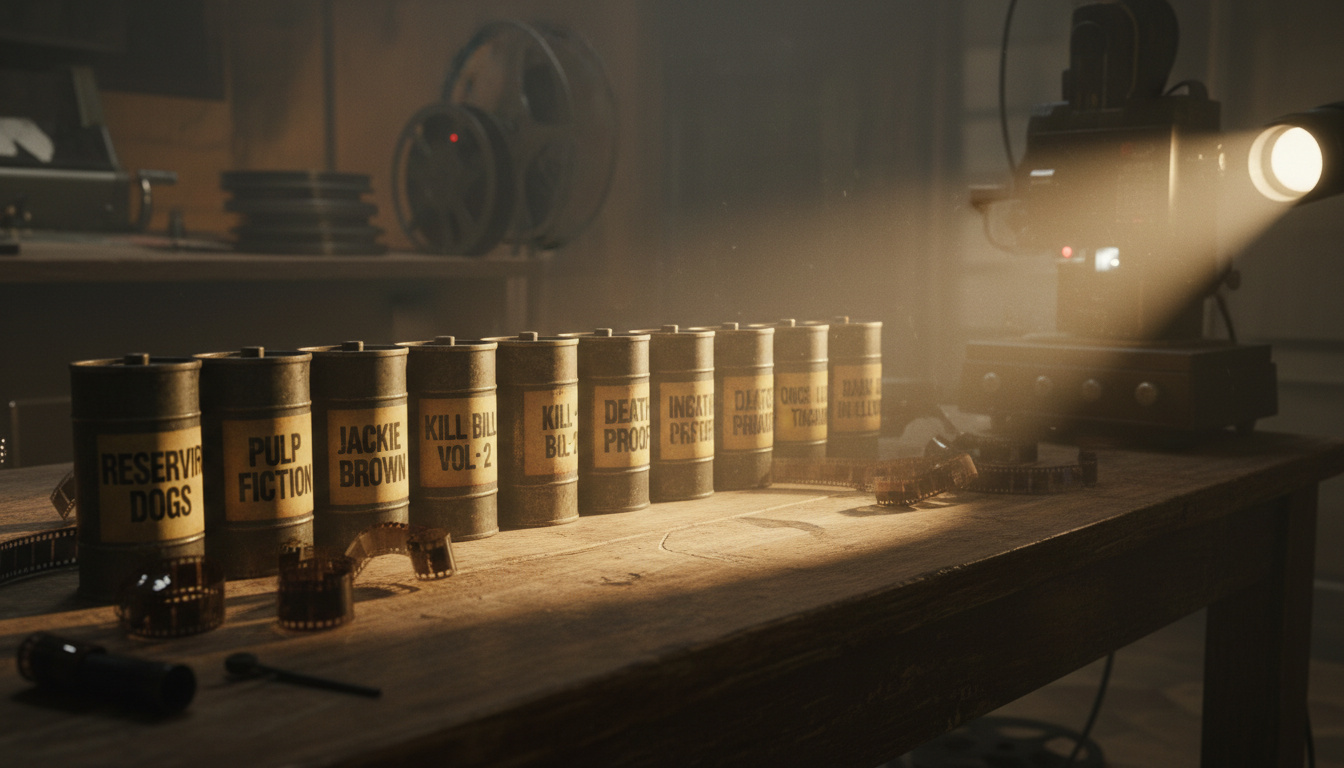
Quentin Tarantino has directed ten feature films between 1992 and 2019, establishing a filmography distinguished by nonlinear narratives, razor-sharp dialogue, and meticulous genre pastiche. His work draws extensively from spaghetti westerns, blaxploitation cinema, and French New Wave influences, creating a signature style that has garnered both critical acclaim and substantial commercial success.
For decades, Tarantino maintained his intention to retire from directing after completing ten films, a declaration that positioned Once Upon a Time in Hollywood (2019) as his ostensible final work. However, current developments regarding The Adventures of Cliff Booth, a spin-off from that film, indicate this retirement may yet be deferred. This guide examines his complete directorial output in release order, explores the critical consensus on his strongest works, and clarifies common misconceptions regarding his involvement with certain projects.
Quentin Tarantino Movies in Order
Tarantino’s filmography spans three decades, beginning with the independent breakout Reservoir Dogs in 1992 and extending through his most recent theatrical release. Below is a comprehensive overview of his directorial career, supplemented by key statistical insights and a detailed breakdown of each feature.
Total Directed Features
Highest Grosser (Django Unchained)
Top Tomatometer Score (Pulp Fiction)
Latest Theatrical Release
Key Characteristics of the Filmography
- Nonlinear Chronology: Multiple films employ fragmented timelines and chapter-based structures, notably Pulp Fiction and The Hateful Eight.
- Ensemble Casting: Recurring collaborators include Samuel L. Jackson, Harvey Keitel, Tim Roth, and Zoë Bell across multiple productions.
- Genre Homage: Each film explicitly references exploitation cinema, westerns, martial arts pictures, or war films whilst subverting their conventions.
- Screenplay Authority: Tarantino has written or co-written every film he has directed, with Pulp Fiction earning him an Academy Award for Best Original Screenplay.
- Revival Performances: His casts frequently feature actors experiencing career resurgences, such as John Travolta in Pulp Fiction and Jennifer Jason Leigh in The Hateful Eight.
- Cinematic Universes: Characters and brands interconnect across films, including the Red Apple cigarettes and the Vega brothers mythology.
Complete Filmography Data
| Film | Year | Runtime | Tomatometer | Oscars | Budget |
|---|---|---|---|---|---|
| Reservoir Dogs | 1992 | 99 min | 90% | — | $1.2M |
| Pulp Fiction | 1994 | 154 min | 92% | 7 nominations, 1 win | $8M |
| Jackie Brown | 1997 | 154 min | 87% | — | Not specified |
| Kill Bill: Volume 1 | 2003 | 111 min | 85% | 1 nomination | $30M |
| Kill Bill: Volume 2 | 2004 | 137 min | 84% | — | $30M |
| Death Proof | 2007 | 113 min | 76% | — | Not specified |
| Inglourious Basterds | 2009 | 153 min | 89% | 8 nominations | $70M |
| Django Unchained | 2012 | 165 min | 87% | 5 nominations, 2 wins | $100M |
| The Hateful Eight | 2015 | 168 min | 75% | 3 nominations, 1 win | Not specified |
| Once Upon a Time in Hollywood | 2019 | 161 min | 85% | 10 nominations, 2 wins | $90M |
Sources: Wikipedia, Rotten Tomatoes, Box Office Mojo
How Many Quentin Tarantino Movies Are There?
The precise count of Tarantino’s directorial features depends upon how one categorises the Kill Bill volumes and whether unfinished projects factor into the total. Canonical filmographies, including those maintained by Tarantino Archives, recognise ten completed theatrical features.
The Canonical Ten Features
Tarantino’s official directorial corpus comprises ten films released between 1992 and 2019. This count excludes unfinished student projects such as My Best Friend’s Birthday (1987), which never received a full theatrical release, and uncredited directorial segments in anthology films. Each of the ten features represents a complete narrative work written and directed by Tarantino himself.
The Kill Bill Volume Debate
A persistent point of contention arises regarding Kill Bill (2003–2004), originally conceived as a single film but bifurcated into two volumes for theatrical distribution. The story functions as a continuous narrative, with the combined cut Kill Bill: The Whole Bloody Affair premiering in 2004. Some analyses suggest counting the project as one film would reduce Tarantino’s total to nine features—though standard reference sources list them separately, maintaining the count of ten.
Tarantino has publicly vowed to retire from directing after his tenth feature film, a statement he reiterated throughout his career. This proclamation initially designated Once Upon a Time in Hollywood as his final work, though the subsequently announced The Adventures of Cliff Booth suggests this limit may ultimately comprise eleven entries.
Quentin Tarantino Best Movies
Critical consensus and audience metrics largely align regarding the pinnacle of Tarantino’s filmography, though different platforms emphasise various aspects of his craft. Aggregated data from Rotten Tomatoes, IMDb, and Letterboxd reveal consistent patterns in the reception of his work.
Critical Darlings and Award Recognition
Pulp Fiction (1994) dominates critical rankings, holding the highest Tomatometer score at 92–94% and securing the Palme d’Or at the Cannes Film Festival. The film earned seven Academy Award nominations, including Best Picture, with Tarantino and Roger Avary winning for Best Original Screenplay. Inglourious Basterds (2009) and Django Unchained (2012) follow closely in critical estimation, with the latter achieving two Oscar wins from five nominations.
Audience Rankings and Cultural Impact
User-generated scores on IMDb and Letterboxd similarly position Pulp Fiction at the apex, typically scoring 8.9/10 or equivalent. Reservoir Dogs and Inglourious Basterds maintain strong audience favour, whilst Death Proof represents the sole title to elicit notably divided reactions, reflecting its status as part of the Grindhouse double-feature experiment.
Pulp Fiction universally tops rankings across Wikipedia, Rotten Tomatoes, Letterboxd, and dedicated Tarantino archives. Its influence on 1990s independent cinema and popular culture remains unmatched within his filmography.
Quentin Tarantino Movies New
Despite his stated retirement intentions, Tarantino continues developing new projects, with particular attention focused on a potential eleventh directorial feature and various writing credits.
The Adventures of Cliff Booth
Currently in post-production, The Adventures of Cliff Booth revisits the character portrayed by Brad Pitt in Once Upon a Time in Hollywood. Slated for release in 2026 or 2027, this project marks Tarantino’s return to the director’s chair after a five-year hiatus and may ultimately constitute his formal retirement film.
The Projectionist and Other Credits
Tarantino has committed to writing The Projectionist, scheduled for 2026, though he will not direct this particular feature. This distinction remains crucial for maintaining accurate filmographies, as his directorial count should not include projects where he serves solely as screenwriter.
Streaming Availability
No definitive 2026 data confirms Netflix availability for Tarantino’s filmography. Licensing agreements vary significantly by region and temporal window; viewers should consult streaming platforms directly for current territorial availability.
Whilst The Adventures of Cliff Booth carries a tentative 2026/2027 release window, post-production timelines remain subject to change. Tarantino’s exact retirement status also remains undefined pending this release.
Quentin Tarantino Movies Release Timeline
- 1992 — Reservoir Dogs: Debut feature premiering at Sundance; establishes the nonlinear narrative approach.
- 1994 — Pulp Fiction: Palme d’Or winner at Cannes; redefines independent cinema.
- 1997 — Jackie Brown: Adaptation of Elmore Leonard’s Rum Punch; more mature, character-driven approach.
- 2003 — Kill Bill: Volume 1: Martial arts revenge epic; homage to Shaw Brothers cinema.
- 2004 — Kill Bill: Volume 2: Conclusion of the Bride’s narrative; western influences prominent.
- 2007 — Death Proof: Part of Grindhouse double feature with Robert Rodriguez.
- 2009 — Inglourious Basterds: World War II alternate history; Christoph Waltz’s breakthrough performance.
- 2012 — Django Unchained: Highest-grossing film; slavery-era western revenge narrative.
- 2015 — The Hateful Eight: Agatha Christie-style western mystery; 70mm roadshow presentation.
- 2019 — Once Upon a Time in Hollywood: Love letter to 1969 Los Angeles; multiple Oscar wins.
Quentin Tarantino Movies: Established Facts and Ongoing Ambiguities
Verified Information
- Tarantino has directed exactly ten theatrical feature films
- Pulp Fiction holds the highest critical aggregate scores
- Django Unchained represents his highest-grossing theatrical release
- He did not direct From Dusk Till Dawn (1996); Robert Rodriguez served as director
- Once Upon a Time in Hollywood was initially declared his final film
Remaining Uncertainties
- Whether Kill Bill constitutes one film or two for retirement counting purposes
- Exact theatrical release date for The Adventures of Cliff Booth
- Confirmation of Netflix territorial licensing agreements
- Whether Tarantino will definitively retire after the Cliff Booth project
- Potential for additional Star Trek or other genre projects previously discussed
The Tarantino Cinematic Universe
Beyond standalone narratives, Tarantino has constructed interconnected cinematic universes through shared brands and familial relationships. The Red Apple cigarettes appear across multiple films, whilst characters such as Vic Vega (Reservoir Dogs) and Vincent Vega (Pulp Fiction) are established as brothers—though Tarantino has suggested a potential Vega Brothers film remains unlikely given the actors’ current ages.
His stylistic hallmarks—the trunk shot, extreme close-ups of feet, chapter titles, and anachronistic soundtrack selections—create authorial continuity regardless of genre setting. These techniques, borrowed from Tim Burton Movies – Complete Filmography in Order contemporaries and exploitation cinema predecessors, position his work within broader discussions of postmodern cinema alongside directors such as the Coen Brothers and Wes Anderson Movies – Complete List In Order and Ranked.
The cultural impact extends to revitalising Morricone’s western scores for new audiences and resurrecting careers of actors including David Carradine and Kurt Russell whilst introducing international stars such as Christoph Waltz to American audiences.
Sources and Verification
This filmography relies upon primary sources including the verified Wikipedia filmography and Tarantino Archives for release dates and production details. Critical rankings derive from Rotten Tomatoes aggregate scores and Letterboxd user data. Academy Award verification utilises official Academy records.
“I intend to retire after my tenth film. I like the idea of leaving them wanting more.”
— Quentin Tarantino, regarding his self-imposed film limit
Summary: The Complete Tarantino Filmography
Quentin Tarantino has directed ten feature films chronicling an evolution from independent crime cinema to historical revisionist epics. From Reservoir Dogs’s brutal minimalism through Once Upon a Time in Hollywood‘s sun-drenched nostalgia, his work maintains consistent thematic concerns with violence, redemption, and pop-cultural referentiality. With The Adventures of Cliff Booth approaching completion, audiences await whether this represents his definitive farewell or the commencement of a new chapter. For those exploring similarly distinctive directorial voices, consider examining the Tim Burton Movies – Complete Filmography in Order for gothic fantasy perspectives.
Frequently Asked Questions
Did Quentin Tarantino direct the vampire film From Dusk Till Dawn?
No. Whilst Tarantino wrote the screenplay for From Dusk Till Dawn (1996) and appears in the cast as Richie Gecko, Robert Rodriguez directed the feature. Tarantino served as executive producer on subsequent direct-to-video sequels.
Why do some sources list only nine Quentin Tarantino films?
This discrepancy stems from Kill Bill originally being conceived as a single film. Some analyses count the two volumes as one entry, reducing the total to nine. Standard filmographies, however, recognise the separate theatrical releases of Volume 1 (2003) and Volume 2 (2004).
Which Tarantino film won the Palme d’Or at Cannes?
Pulp Fiction (1994) won the Palme d’Or, sharing the prize with 1942: A Love Story from India. This remains his sole Golden Palm, though several subsequent films competed at the festival.
What is Quentin Tarantino’s highest-grossing film?
Django Unchained (2012) represents his highest-grossing theatrical release, earning approximately $425 million worldwide against a $100 million production budget.
Will The Adventures of Cliff Booth definitely be his final film?
Whilst initially announced as his retirement project following Once Upon a Time in Hollywood, Tarantino has not definitively confirmed this status. The film remains in post-production with a tentative 2026 or 2027 release date.
Are the Kill Bill volumes available as a single film?
Yes. Kill Bill: The Whole Bloody Affair combines both volumes into a single edit, originally screened in 2004. However, this cut received limited theatrical exhibition compared to the separate releases.
Does Tarantino appear in all his films?
Tarantino typically makes cameo appearances in his features, ranging from substantial roles such as Mr. Brown in Reservoir Dogs to voice-only contributions as the narrator in The Hateful Eight miniseries edit.
Related stories





Leon Carter covers cinema releases, movie cast guides and filmographies.